Monday, February 27, 2023

Ramsey Campbell's Box

So, sometimes what is collectable and what isn't can be a bit murky. A case in point wd be Ramsey Campbell's box.


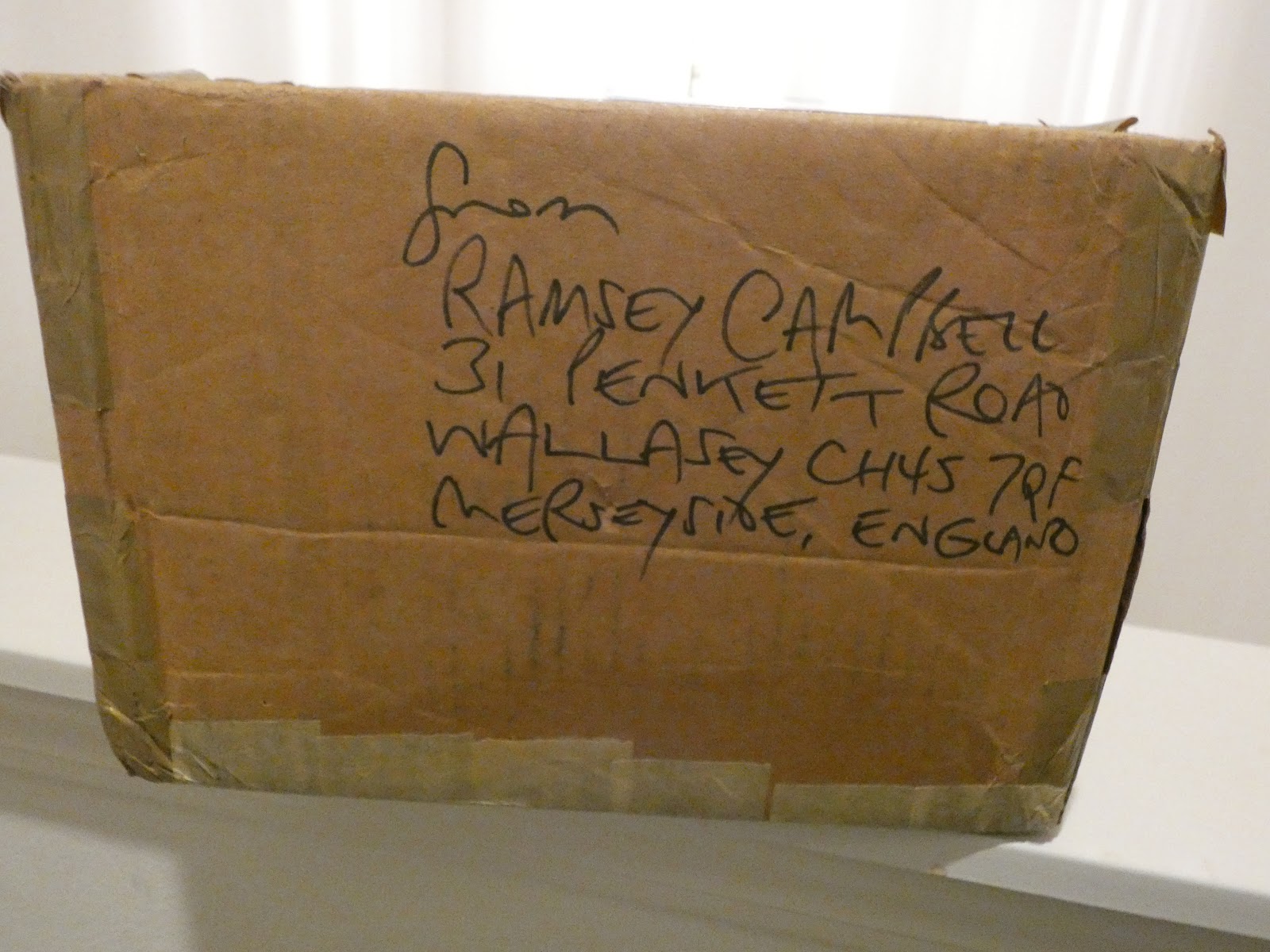
This is a somewhat battered cardboard box*, on one side of which British horror writer Ramsey Campbell** has written his return address (the top flaps have the recipient's address).


How I got this is fairly straightforward. My friend Doug Anderson was in town, on a book tour promoting his new book THE ANNOTATED HOBBIT, second revised edition.*** While he was in the neighborhood we (Janice, Doug, myself) went over to Bremerton to see Jessica Amanda Salmonson.**** Being bookish people, during our visit we looked over books she had for sale. I don't remember any specific book I bought, only that it must have been enough of a pile that she gave me a little box to put them in rather than a bag.  I don't think I noticed the writing on the side until later, but I may be misremembering there.

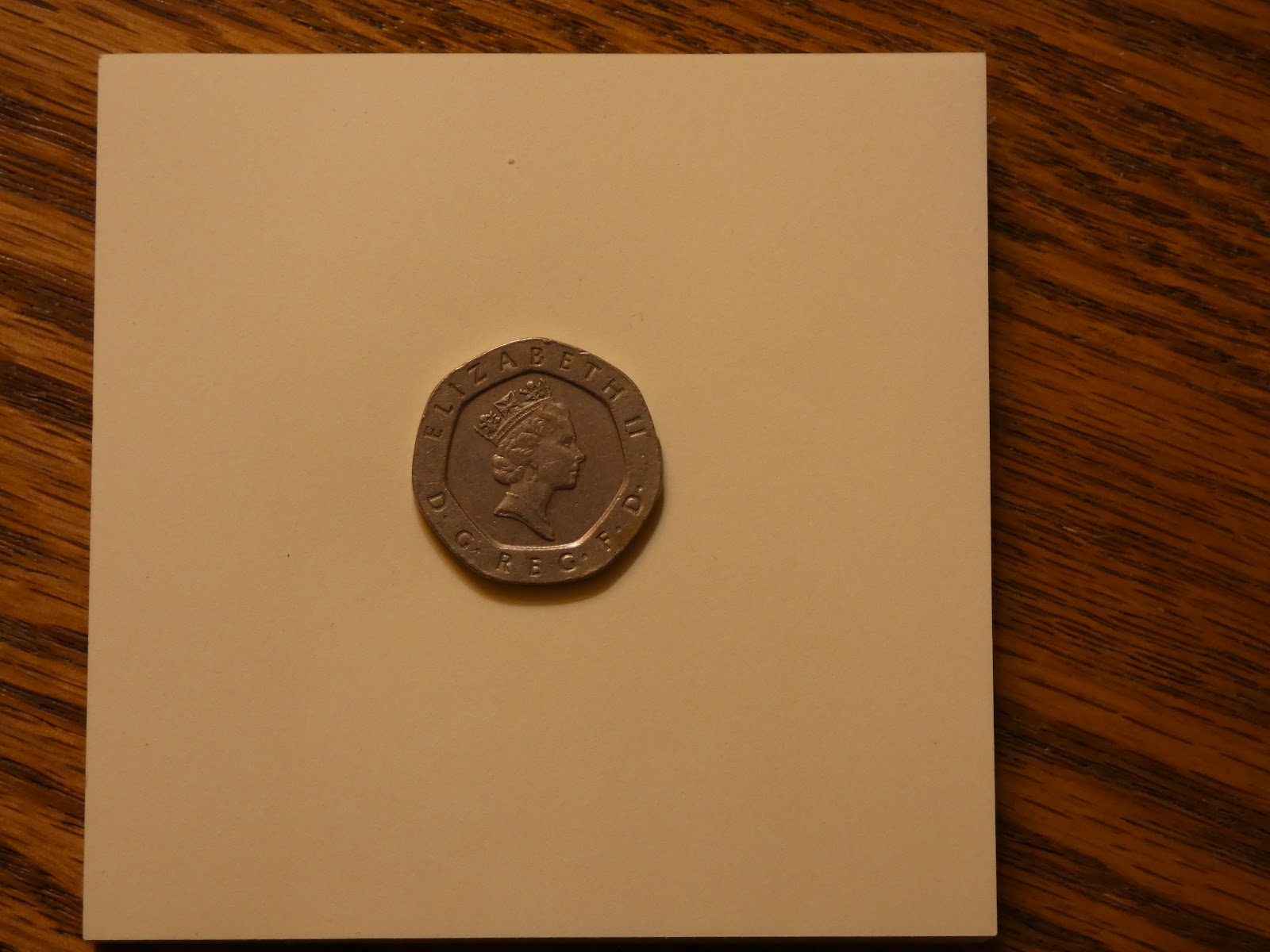
So there it is: I have provenance (assuming it's actually his handwriting and not that of a secretary), right down to the 20pence piece that fell out of it while I was measuring the dimensions last night. To put it another way, I think it's authentic but any value it might have wd be only for fans and come only through its associational value.

Still, it makes for a fun conversation piece. Especially considering how many Mythos tales begin with the arrival of some unexpected parcel . . . 

--John R.

--current reading: ALWAYS COMING HOME by U. K. Le Guin


*8 1/2" high, about 12" long, and 8 inches wide 

**best known, to me anyway, for his Severn Valley Mythos tales, which made him the first of a new generation of Cthulhu Mythos writers who had not known Lovecraft himself.

***a v. gd bk, which you shd pick up if you're interested in JRRT.

****and also, at some point during Doug's trip, we got together with John Pelan, who sold me a copy of Leiber stories. 


NERDcon 2023

 So, Saturday I went into downtown Kent to attend NERDcon (or NerdFest, or more formally the Meeker Street Nerd Party). This is my second time there, and I was impressed how many more people showed up than last time. Here's the official description:

https://www.downtownkentwa.com/event/meeker-street-nerd-party/

Don't know details, but I do know turnout was good enough that they're already planning the next one, which I gather will start up an every-six-months schedule.

I had intended to take a small stack of the little booklet version of Dunsany's CHU-BU & SHEEMISH but cdn't find where in the box room I'd put them. So I took a set of the two-volume trade paperback HISTORY OF THE HOBBIT instead, more to feel less self-conscious for taking up one of their chairs. Pity my author's copies of the new one-volume edition, due to arrive in a few days, didn't make it in time.

https://www.harpercollins.com/products/the-history-of-the-hobbit-j-r-r-tolkien?variant=40991777587234

Still, it made a good discussion point for folks wandering by. Maybe I'll get a shirt made up (Talk to me about Tolkien) for next time.

In addition to hanging out with some of my fellow Alliterates (Jeff, Steve M, Stan, Will) I also got to see Tim Beach, an old friend from TSR days* I hadn't run into for several years.** 

--John R.

*Tim started at TSR just a few months after I did: April 1992 I think (whereas I was October 1991, along with Rich Baker, Thomas Reid, and Wolf Baur)

**due no doubt to the odd phenomenon of my thinking Tacoma is much further away than Seattle or Bellevue. 


Wednesday, February 22, 2023

Paved with Good Intentions

So, recently I've been seeing articles in the news about the Rahl Dahl Story Company (formerly the Dahl estate, now owned by Netflix) making changes in Dahl's text:

https://www.theguardian.com/books/2023/feb/18/roald-dahl-books-rewritten-to-remove-language-deemed-offensive

https://www.theguardian.com/books/2023/feb/20/roald-dahl-books-rewrites-criticism-language-altered


This is just the latest of a string of modern-day rewritings of stories by famous authors who have passed on, as with the DOCTOR DOLITTLE books. That earlier well-intentioned attempt shows just how insidious such efforts can be--in the case of Hugh Lofting's books they edited out not just objectional art but also factional elements like a favorable reference to Darwin.

The most interesting part of the whole enterprise, to me, is the insistence of those carrying out this Bowdlerization that what they're doing isn't censorship. Whereas in the past such changes were made on an ad hoc basis, I find it fascinating to learn that there's now a group publishers can go to, Inclusive Minds. Here's how the group describes its work (https://www.inclusiveminds.com/about).

Occasionally publishers approach us to consult Inclusion Ambassadors when looking to reprint older titles. Whilst this is not the main focus for the Ambassadors (and we believe better authenticity is achieved through input at development stages), we do think those with lived experience can provide valuable input when it comes to reviewing language that can be damaging and perpetuate harmful stereotypes. In all our work with marginalised young people, the very real negative impact and damage caused to self-worth and mental health from biased, stereotypical and inauthentic representation is a recurring theme.

On any project, it’s the role of the ambassador to help identify language and portrayals that could be inauthentic or problematic, and to highlight why, as well as indicate potential solutions. The publisher (and / or author) are then able to make informed decisions regarding what changes they wish to make to manuscripts and illustrations. Inclusive Minds is here to connect people with relevant lived experience to help in the wider process and do not edit or rewrite text.

 'Ambassadors': the people who read through the work and propose changes. The group prefers its 

'Inclusion Ambassadors' be present during the creation of the work; certainly before its publication.

On their website Inclusive Minds takes care to emphasize that they don't edit or rewrite. Instead of making changes to a heirloom text submitted for their scrutiny, they provide the publisher with a list of things that need to be changed to bring it in accord with the current sensibilities.


Tolkien's position on all this is clear. He was against Bowdlerization, preferring instead to push back the target audience to older readers while preserving the text intact: 

The beauty and horror of The Juniper Tree . . . with its exquisite and tragic beginning, the abominable cannibal stew, the gruesome bones, the gay and vengeful bird-spirit . . .  Without the stew and the bones --which children are now too often spared in mollified versions of Grimm* --that vision wd largely have been lost.

* [JRRT Note]: They shd not be spared it --unless they are spared the whole story until their digestions are stronger.

The tale Tolkien is discussing here is one of the Brothers Grimm; the 'vision' is of 'distance and a great abyss of time.'

( OFS .48).


--John R

current reading: HISTORY BITES: THE LIFE & WORKS OF J. R. R. TOLKIEN by Solomon Schmidt (2019)

also THE COMPLETE ENOCHIAN DICTIONARY by Donald C. Laycock (sans the actual dictionary parts), 1994.


Monday, February 20, 2023

My Bad

So, a week or so back I made what was supposed to be the first of two teaser posts leading up to a discussion of ne of my favorite pieces I worked on from back in my TSR days. Re-reading my post now I see my phrasing led folks to think I was trying to identify some old art when I actually just wanted to share a relic of the past (particularly, my past). So thanks to Allan (grodog) and Dick McGree and apologies if they put in any time on this.


That said, here are two more pieces from the same little stash, the first of which is definitely from THE GATES OF FIRESTORM PEAKE; it's by Arnie Swekel (as were at least two of the three pieces in my last post) and cost the kingly sum of $3. The second I'm think is unassociated: simply something I picked up at artists' row outside the GenCon dealers' room circa 1996 or 1997.

While gaming professionals put in the work on every project, or should, we all have a few favorites, and this is one of mine. Aside from being a really good module, it stands out in a number of ways. For one thing it was Bruce Cordell's first publication after he came on-staff and, because of TSR's shut down for the first half of 1997, was the only one of his pieces to see print for quite a while (his first year or so at TSR)—after which came a healthy flood that included impressive works such as the Award-winning RETURN TO THE TOMB OF HORRORS: designed (by Bruce) and partially edited before the break (by me), editing completed during the hiatus (by Steve Winter), published after the move out to Renton.

I cd be wrong on this, but I think GATES OF FIRESTORM PEAK marked the first appearance of The Far Realm, bringing a Cthuhoid touch to D&D (which to my way of thinking was all to the good).

Less successful was the mandate that this adventure use the new PLAYER'S OPTION rules -- a venture best described by Skip Williams, I think it was, as 'making D&D more like the games we'd been outselling for twenty years'.* It did I think have the positive effect in that it can be seen as a dry run for Third Edition. The lack of enthusiasm with which it was greeted probably played a role in ruling out that path as the way to go --first for late-stage TSR and then for early work on 3e Wotc.

So there it is: I count it as one of the high points of the fifteen years I spent at TSR / WotC / Hasbro that I got to edit Bruce Cordell's first TSR module. 


--John R


--current gaming: 

D&D Fifth Edition: FORBIDDEN CAVERNS OF ARACHAIA (Monday night group)

CALL OF CTHULHU Seventh Edition: BERLIN, THE WICKED CITY (Saturday night group)


*have to say I liked the PLAYER'S OPTION: SPELLS & MAGIC book in itself, just didn't think it was a good direction for the mainline of the game.

Again, apologies for not getting this follow-up posted in good time.

--John R.

Monday, February 13, 2023

Ring Any Bells?


So, sorting through another box of papers (circa 1995) I came across some of the few pieces of original art I have from TSR days. These came from a product I actually worked  on: anyone out there remember these?

--John R.

Friday, February 10, 2023

The Cat Report (2/10-23)


So,  we went from no cats at all to six here in Renton, almost a full house.


First up there is OLIVE, who I think has already decided that the cat room is hers and all the rest mere residents to be ignored. I couldn't get the leash on her properly so no walk for her at the start of the shift, but she did explore the room and asked for, and got, a lot of attention.  She did get a proper walk at the end of the shift and did quite well.

Next up the two kittens, FLEECE & FLANNEL, wanted attention but were too shy to come out, especially the lighter, fluffier one. So they played in their cage. They liked the smell of catnip but best of all were gopher games involving sticks and strings, especially the chopstick. I snatched up the bolder of the two (the darker one) to let him explore. This led to difficulties. He dashed around the room,  too skittish to let me pick him up and unsure whether he cd make make the leap back up into his cage on his own. We resolved the problem by putting one of the large, hard-topped cat-carriers with a towel on top just outside (below) his cage. That did it: he jumped from floor to carrier-top to inside his cage, I think pleased with himself. His partner had no adventures, which is probably just as well.

PRINCESS is our biggest, oldest, and most regal of the new set. She didn’t come out but loved attention, whether a good game or a good stritch on the back of the next. She lets you know when you’re doing it right by stretching out her legs and massaging your arm with her paws, purring all the while. 

ZERO was the first of our stay-inside hiding under blankets cat. You can reach in and pet him? her? but looks like it’ll take time and attention to help her come out of the shell.

That just left CARDAMON, another burrower, who was not much interested in games, or being petted, and definitely no fan of any plan that involved her coming out of that cage; I forgot to try her with catnip spray.


A shy lot of cats, but no telling how much of that is due to being in a strange new place.

—John R


Friday, January 27, 2023

NEW BIOGRAPHY OF WARNIE LEWIS


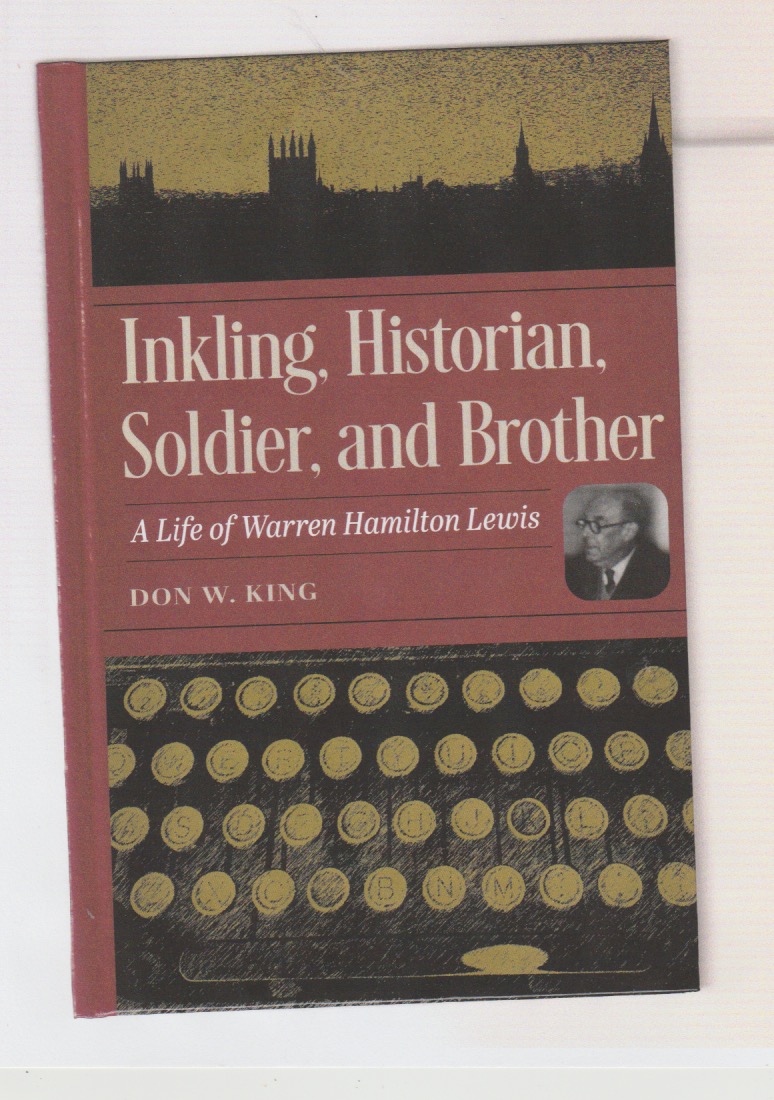
So, it's taken me a while, but I've finally made my way through Don King's new book, the first book-length biography of Warnie Lewis. It's not that long (200 pages plus notes) but does a good job of rehearsing the story familiar to those of us interested in the Inklings, expanding on it in the process. There is new information but few revelations: it does not widen our knowledge of WHL so much as deepen it.


For example we knew Warnie had served in World War I; King describes his duties, ranks, promotions, and the like, focusing on his experiences as an officer in the service corp --not on the front line but not far behind it either. 


Similarly we knew Warnie was a ditchcrawler who loved to take his canal boat on excursions on quiet backwaters throughout the 1930s; King recounts several such trips in Warnie's own words, taken from his now-lost logbooks.*


Those reading this book for its C. S. Lewis connection may be distressed over the detailed description of Warnie's alcoholism, binge by binge, and Warnie (and King's) treatment of Janie Moore, the love of CSL's life.


First off, there's the oddity of his usage 'Moore'. In his Introduction King explains how, finding it awkward to have two Lewises on his hands (CSL and WHL), he chooses in the pages which follow to call W. H. Lewis, the subject of this biography, 'Warnie', which is standard in Lewis studies. The younger brother, C. S. Lewis, he calls 'Jack' (the family nickname, used by close friends), despite knowing some Inkling scholars wd object to this usage (myself among them) [xiii-xiv].  When it comes to naming the inhabitants of the Kilns in the early 1930s, King calls them Jack (=CSL), Warnie (=WHL), Maureen (Mrs. Moore's daughter), and Moore (=Janie Moore).


The last of these four is usually called 'Mrs Moore' by Lewis scholars. But if King felt the need to refer to her by a single-word name, it wd have been better to use her first name, Janie, rather than her last, which has the effect of distancing her from the little community at the Kilns. This is all the more the case because when he comes to introduce Joy Gresham into the family she quickly becomes 'Joy' rather than 'Gresham' or 'Davidman'.


It's pretty clear from various accounts that Janie suffered from Alzheimer's (King refers to it both as 'insanity' and as 'dementia') increasingly through the latter half of the 1940s, until she was moved to a nursing home for her final months in 1950-51. It's also clear that her senility was a late development—the description of Janie M's room during the final stages of her Alzheimer's is particularly appalling:


On January 17, 1950, some relief came as Bruce —an animal that Warnie had come to despise as much as Moore— died. Warnie related that in the dog's final days, as Moore's mind began to slide more quickly toward insanity, having someone walk Bruce was an obsession for her. Often Moore insisted that Jack take the dog out three times in an hour. Warnie's disgust with the entire matter culminated in his writing: "For months past [Bruce] had [[defecated]] in M's tiny overheated bedroom and stunk out the house. How she stood living in what was practically an open latrine I don't know, but that was her affair . . . . I am resting now in a delicious unaccustomed peace; but I wish Paxford had been able to bury the stench as well as the dog!  (King, p.131)**


I have to say that given her limited mobility in her final years (King ascribes it to varicose veins), sharing her room with an incontinent dog makes Mrs. Moore's concern over getting it outside to do its business seems thoroughly justified. One wishes Warnie had stepped up to give his brother a break and just taking on the chore and walked the dog himself. Like I said, distressing.


Disturbing in another sense is King's suggestion that the Inklings may have unwittingly contributed to Warnie's losing control over his alcoholism. That is, attending two weekly gatherings which both included social drinking, one of them in a bar, cd have caused difficulties. Or, as King puts it:


Warnie's downward spiral was quickened 

by the frequency of Inkling gatherings (.146)


I wd v. much like this not to be true.


Finally, there's what I think the most valuable bit in the whole book: a compiled chart of how many Inklings meetings we have evidence for, broken down year by year (page 142). By his reckoning there are 93 documented meetings, with the years with the most recording meetings are 1946 and 1947 (17 each) with 1944 (16) a close runner-up. By contrast, there was only a single recorded meeting in 1941, 1943, 1952, and 1954, with none at all in 1953. Of course King's standards might differ from others over what qualifies as a 'recorded meeting'.


Interesting to see that King's tally confirms what I had long since concluded on my own: that the four members who attended most often, the regulars, were CSL, JRRT, WHL, and Dr. Havard.***  I hope King will return to this compilation and build upon it for a future project; it wd make a good book in itself. 


In the end: if you're only going to read  one book on or by the Major, it shd be BROTHERS AND FRIENDS (1985), the edition of his diaries put together by Clyde Kilby and Marj. Mead. And the second shd be King's INKLING, HISTORIAN, SOLDIER, and BROTHER: A LIFE OF WARREN HAMILTON LEWIS.


--John R.


*Warnie used these as the basis of several articles of advice on ditchcrawling; King discusses and summarizes these in his excellent essay "Warren Lewis: The Soldier Sailor" published in the fall 2021 issue of the JOURNAL OF INKLING STUDIES (Vol.11 Issue 1) pages 58-69.

**In one of the books on Joy Davidman we're told one of the first things she did upon arriving at the Kilns was to do a thoroughgoing cleaning of the Kilns. If King's account is fair then no wonder.

***What evidence we have suggests these were also the ones who attended the longest although King does not address this point.